
 By
By Havana’s energy crunch did not begin with a new sanctions law or a blockade announcement; it accelerated when Washington signaled it was ready to punish third countries that continue to supply Cuba’s fuel.
In a market where ships, insurers, and banks move faster than diplomats, that warning was enough to stall cargoes, tighten credit, and leave the island scrambling to keep the lights on, buses running, and hospitals supplied.
As traditional suppliers stepped back, the gaps are increasingly being filled by geopolitical allies like Russia, shifting Cuba’s oil ties rather than erasing them.
Tariff threats, fast freeze
The immediate shock came from threats of trade retaliation, tariffs on countries that supply Cuba with fuel, rather than a clean, legislated expansion of the embargo.
According to Kpler data, Mexico delivered a small cargo on January 9, but “a few weeks later,” Trump threatened tariffs on any nation supplying Cuba with fuel, and that flow stopped.
This is how “soft” pressure becomes real-world disruption.
Shipping firms, commodity traders, insurers and banks tend to pause first, because secondary-penalty risk is hard to price and easy to overestimate.
A July 2025 Trump national security memorandum tightening Cuba policy was also widely read as an attempt to widen extraterritorial exposure, deterring third-country business from Cuba across sectors, including energy and fuel supply.
The timing matters because Cuba’s buffer is thin.
The analysts estimate that Cuba has fewer than 20 days of oil in storage, meaning even short delivery gaps can force emergency rationing decisions.
Why are shortages paralysing Cuba fast?
Fuel scarcity hits Cuba like a system failure, not a single-sector problem.
The energy experts have warned that if diesel runs short, the impact would be “catastrophic,” because it underpins passenger and freight transport, rail, agriculture and even water distribution.
Cuba’s power system was already fragile before the latest supply scare.
Cuba’s crude and fuel imports in the first 10 months of 2025 of the year fell by about 35% versus the same period of 2024, down to roughly 45,400 barrels per day from 69,400.
The massive reduction came after Mexico and Venezuela reduced shipments, making it harder to ease daily power cuts.
The imports from Venezuela, Cuba’s most important political ally, were down nearly 15% to about 27,400 bpd, squeezing fuel oil supplies used for power generation.
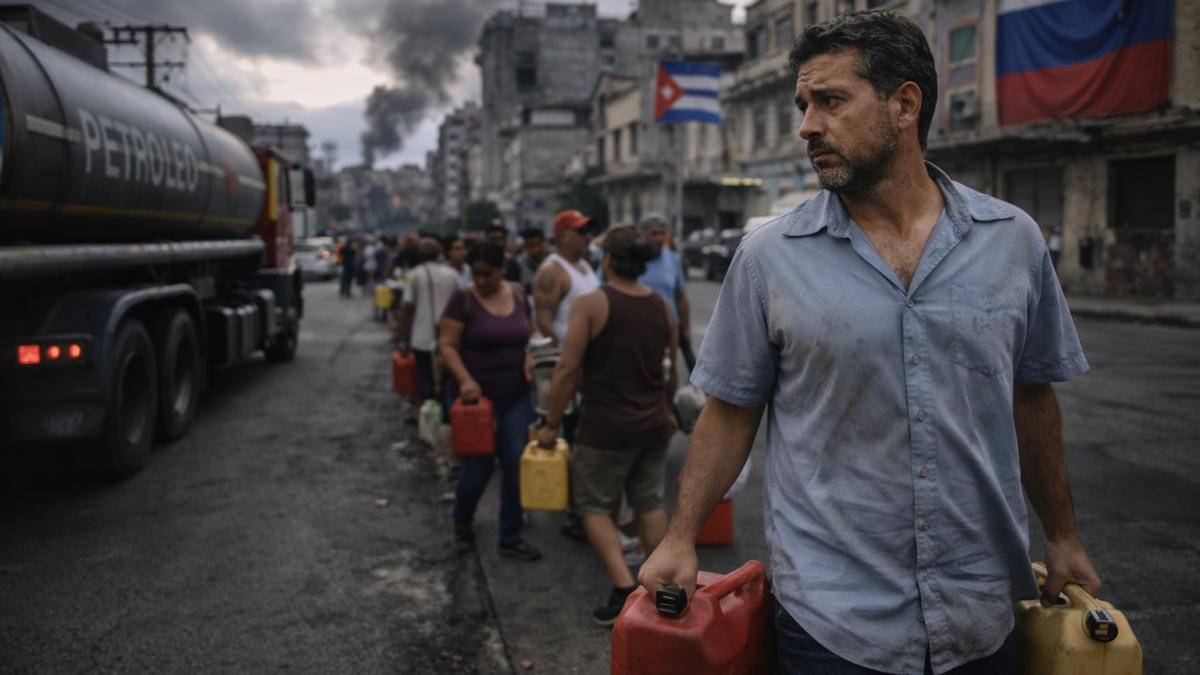
That macro squeeze shows up quickly on the street: fewer buses, longer gasoline lines, and longer blackouts.
Cuba responded with contingency measures, including reducing public transportation routes, shortening the work week to four days, shutting down resorts, and limiting gasoline sales to consumers who can pay in dollars.
Read More: Chronicles of Caracas from the ground: blackouts, blasts, and empty shelves
Human fallout, rationing politics
As the grid and transport stumble, knock-on effects spread through healthcare, schooling, and food distribution, areas that depend on reliable power and diesel-backed logistics.
Cuba postponed its annual cigar fair as the fuel crunch and blackouts worsened, a visible sign that even priority, hard-currency sectors are being disrupted.
Cuban officials have framed the squeeze as collective punishment while simultaneously rolling out triage measures to protect core services.
The Caribbean Council report on the 2025 memorandum quoted Deputy Foreign Affairs Minister Carlos Fernández de Cossío saying the measures would “cause suffering to the people,” affecting sensitive areas including “fuel supply,” electricity generation and food production.
Even for suppliers who want to help, the practical barrier is often finance and compliance.
Cuba’s limited hard currency constrains spot-market purchases, while counterparties worry that touching the trade could jeopardize their access to US markets or the dollar system.
Who is filling the gap?
The retreat by some suppliers does not remove Cuba’s demand; it reroutes the supply chain toward partners more willing, or more insulated, to take Washington’s risk.
Russia has signaled it is discussing assistance, with Kremlin spokesman Dmitry Peskov telling Reuters:
The suffocating tactics employed by the United States are indeed causing many difficulties for the country. We are discussing with our Cuban friends possible ways to resolve these problems, or at least to provide all possible assistance.
But replacement barrels are not a simple fix.
In November 2025, Russia had delivered only a few shipments of Urals crude that year, broadly consistent with the prior year, and Mexico and Venezuela faced production constraints while Cuba struggled financially to buy fuel on the spot market.
The geopolitical pushback is also growing in the region because tariff threats can spill into broader trade relationships.
Mexico’s President, Claudia Sheinbaum, warned that the threatened tariffs on countries that supply Cuba with critical energy could lead to a humanitarian disaster.
Whether that warning changes supplier behavior is unclear, but the more immediate effect of the US posture has been a chill that pushes Cuba to lean harder on a narrower circle of backers.
Will suppliers return if US pressure eases, or has the perceived compliance risk permanently damaged trust in Cuba-related fuel trade?
The post How US tariff threats froze Cuba’s oil lifeline, and who is picking up the pieces appeared first on Invezz
